

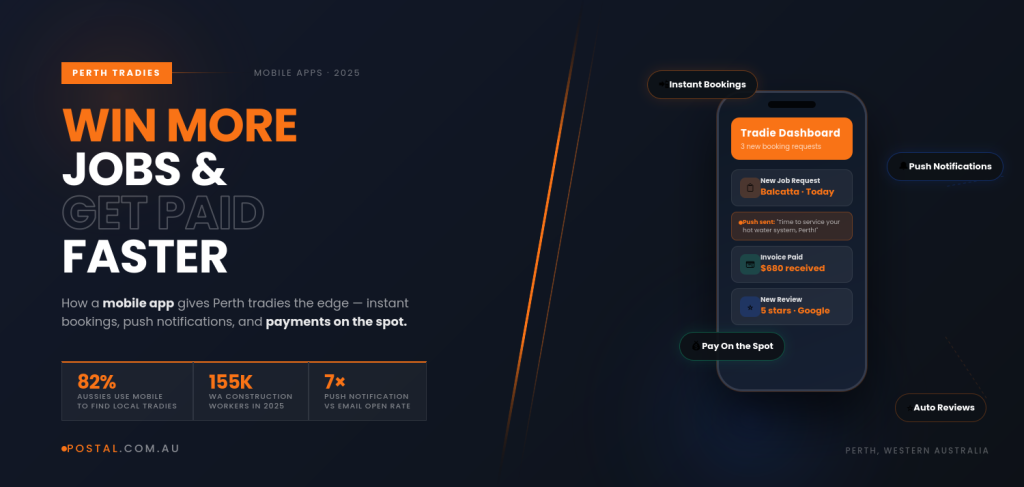
Mobile Apps for Perth Tradies: Win More Jobs and Get Paid Faster
Picture this. You’re on the tools at a job in Balcatta. Your phone rings, you can’t answer. A homeowner in Osborne Park needs an electrician urgently. They call your competitor instead, book in two minutes through their app, and move on with their day. You find out about the missed lead three hours later when you check your messages. This is the reality for thousands of Perth tradies every single day. Western Australia’s construction and trades sector is booming. With 155,500 people employed in construction across WA as of August 2025, a 3.4% increase year-on-year – competition for every job has never been more intense. The tradies winning the most work aren’t necessarily the most skilled. They’re the most accessible, the most responsive, and the most professional in how they present themselves to customers. A mobile app is the single most powerful tool a Perth tradie can have in 2026 to achieve all three. This article explains why and how to get one without breaking the bank. Why Perth Tradies Are Losing Business Without a Mobile App The way Perth homeowners and businesses find and hire tradies has fundamentally changed. Yellow Pages is dead. Word of mouth still matters, but it now starts with a Google search on a phone. Consider the landscape your customers are operating in: 82% Of Australians use their mobile phones for location-based services — including searching for local tradies. (Gitnux / ACMA, 2024) 97.5% Of Australians aged 16+ own a smartphone, with near-universal mobile internet access. (ACMA, 2024) 4hrs 54m The average Australian spends nearly five hours daily on their mobile device — more time than they spend watching TV. (ACMA / Rockingweb, 2024) 155,500 People employed in WA’s construction sector as of August 2025 — making it one of the state’s top 3 employing industries. (ABS Labour Force, 2025) When a homeowner needs a plumber, electrician, or builder in Perth today, they pull out their phone. They search. They compare. They book whoever looks the most professional and responds the fastest. If your business doesn’t have a mobile app or at minimum a frictionless mobile booking experience, you are competing with one hand tied behind your back. The uncomfortable truth: the first tradie to respond wins the job in the majority of cases. A mobile app with instant booking requests means a customer can lock you in at 9pm on a Sunday night, without needing to call, without waiting for a quote, and without giving your competitor a chance. What a Tradie App Can Actually Do For Your Business Let’s cut through the tech jargon. Here are the features that matter for Perth tradies – and the real-world difference each one makes. 1. Instant Job Quoting and Bookings A mobile app lets customers submit a job request or booking directly any time of day or night, even when you’re elbow-deep in a pipe. You receive a notification with the job details, confirm availability with one tap, and the customer gets an instant confirmation. No phone tag. No missed leads while you’re on site. No jobs going to the tradie who picked up first. For tradies running busy sole-trader or small team operations in Perth, this is the single biggest revenue impact a mobile app can have. Every unanswered call is a lost job. An app eliminates that problem entirely. 2. Push Notifications That Keep You Top of Mind How often do your past customers think of you when they don’t currently need a tradie? The honest answer for most businesses: almost never until they need you, at which point they Google someone. A mobile app changes this dynamic completely. Push notifications let you reach your customers directly on their phone’s lock screen with: Seasonal service reminders — “Time to service your hot water system before winter, Perth!” Limited availability alerts — “We have 3 spots left this week — book now” Referral prompts : “Know someone who needs an electrician? Refer a friend and get $50 off your next job” Promotional offers: “10% off all safety inspections this month” Push notification open rates in Australia are up to 7x higher than email. For a Perth tradie with 300 past customers in their app, one well-timed notification can fill a week’s work in minutes. 3. Digital Invoicing and Faster Payments Chasing unpaid invoices is one of the most frustrating parts of running a trades business. You’ve done the work. The customer is happy. But the invoice sits unpaid for two, three, four weeks because they kept meaning to do a bank transfer. A mobile app with built-in invoicing lets you send a professional invoice the moment the job is done — while you’re still standing on the customer’s driveway. They receive it instantly, can pay by card directly in the app, and you see the funds hit your account before you’ve driven to the next job. For Perth tradies managing cash flow across multiple active jobs, this is a game-changer. 4. Customer Reviews Built Into the App Online reviews are the number one trust signal for Perth tradies. A five-star Google review can win you jobs for years. But most happy customers never leave a review — not because they don’t want to, but because it requires effort they’re not going to make unprompted. A mobile app lets you send an automated review request the moment a job is marked complete. The customer taps a button, selects their star rating, and posts a review – all in under a minute, while the experience is fresh. Tradies using automated review prompts consistently build Google review counts three to five times faster than those relying on word of mouth alone. 5. Loyalty and Referral Programs That Drive Repeat Business Repeat customers are the most profitable customers in any trades business, no marketing cost, higher trust, faster jobs because they know your process. A mobile app lets you reward repeat bookings with a built-in loyalty program: Every job earns loyalty points redeemable against future work Referrals from