
Building a startup in Australia today means navigating a mobile landscape that is as unique as the terrain itself. While the “Silicon Valley” advice often trickles down, the reality on the ground in Sydney, Melbourne, or Perth requires a more nuanced approach.
For founders, the choice of platform is more than a technical hurdle; it’s a decision on how to deploy limited capital to reach the highest-value users. Here is the authoritative guide to the Australian mobile market in 2026.
1. The Numbers: Australia’s 2026 Reality
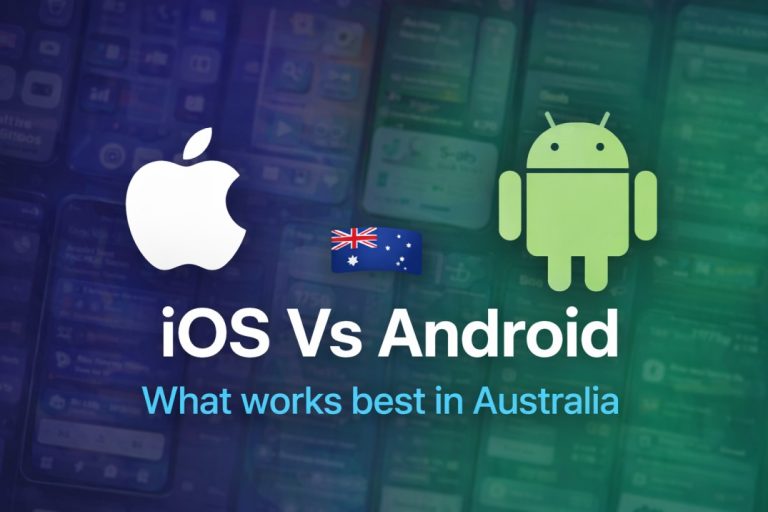
Australia remains a global outlier. While Android dominates the worldwide volume, we are an “iOS-first” nation. If you aren’t on an iPhone, you’re missing the core of the Australian digital economy.
- Total Smartphone Users: ~26.2 million active users—near-total saturation.
- The Market Split: iOS leads at 55% – 59%, while Android holds 40% – 45%.
The Gen Z Factor: Among Australians aged 18–24, 70% use iOS. For this demographic, an iPhone isn’t just hardware; it’s a social necessity. If you are launching a brand that relies on the “youth vote,” you start with Apple.
2. Strategic Verticals: Where iOS Wins
In the Australian market, certain industries have a “natural” home on iOS due to user spending habits and existing infrastructure.
E-Commerce & High-End Retail: Australian iOS users spend significantly more per transaction. With Apple Pay’s deep integration, the “friction to buy” is lowest for urban professionals in our major CBDs.
Education (EdTech): Australia’s private and public school systems are heavily geared toward iPad programs. If your app is for students or teachers, iOS is your primary classroom.
The “Urban” Service: If your startup targets city-dwellers (food delivery, high-end fitness, professional services), you are chasing the iPhone crowd.
3. When Android is the Smarter Shout
Regional & Rural Reach: Outside the metro bubbles, Android’s share climbs. For apps targeting the agricultural, mining, or logistics sectors, Android is the standard.
Hardware Freedom: If your app needs to talk to custom sensors or requires deep Bluetooth/NFC control, Android offers a level of flexibility that Apple’s “walled garden” simply won’t allow.
4. The 2026 Standard: Cross-Platform
For the vast majority of Aussie startups in 2026, the real answer is both.
Gone are the days when “hybrid” meant a clunky, slow experience. Modern frameworks like Flutter and React Native have matured to the point where they offer near-native performance with a single codebase.
Why Cross-Platform is the “Default” Choice:
Unified Feature Parity: You don’t have to tell your Android users to “wait three months” for a new feature. Everyone gets the same experience at the same time.
Maintenance Efficiency: Fixing a bug once—instead of twice—means your dev team spends more time building new features and less time playing “catch-up.”
Market Coverage: Launching on both stores simultaneously ensures you aren’t leaving 40% of the Australian market on the table from day one.
5. The “Founder’s Choice” Framework
| If your goal is… | Then choose… | Because… |
| Gen Z / Premium Retail | iOS First | You need to capture the 70% youth share and high-spend urban users immediately. |
| Industrial / Logistics | Android First | You need hardware flexibility and reach in regional Australia where rugged devices are common. |
| Marketplace / Social | Cross-Platform | These apps require a “network effect.” You need 100% of the market to make the platform viable. |
The Expert Verdict
In 2026, building for just one platform is a luxury most Australian startups can’t afford. Unless you have a hyper-specific technical reason to go native (like high-end gaming or intense AI processing), cross-platform is the most commercial path. It gives you the “Fair Go” reach across the whole country while keeping your burn rate under control. If your startup is based in Perth, for better Perth Status do visit Why Every Perth Business Needs a Mobile App in 2026